GDPR-Compliant AI Note Takers in 2026
In April 2026 Spain’s data protection agency published guidance telling organizations to run data protection checks on the AI transcription tools and vendors they pick, and warning that automation does not reduce their GDPR duties. Bavaria’s regulator and Sweden’s have issued similar guidance. If a meeting is transcribed, you answer for where the transcript goes.
Vendors cannot hand you compliance. A tool can store data in Frankfurt, sign a DPA and never train on your meetings, and you still need a lawful basis, a notice for participants and a retention rule. This guide compares seven tools on what each vendor documents publicly, then covers what stays on your side of the table. Bluedot is listed first, and its limits sit next to the others’.
Key takeaways
- Bluedot stores data in the EU on AWS in Frankfurt by default, offers a DPA with standard contractual clauses, holds SOC 2 Type II and never trains on customer data. Video recording needs the Pro plan.
- Jamie keeps storage and processing inside the EEA, Switzerland and the UK and deletes audio after transcription, so there is no recording to replay.
- tl;dv hosts in Europe and lets you choose where AI processing runs, so check that your workspace is set to Europe.
- Leexi publishes its DPA with a list of ten sub-processors, hosts in Paris and holds ISO 27001.
- Noota hosts in France, Belgium and the Netherlands, but its GDPR page names no certification and no DPA.
- MeetGeek offers EU or US residency, and European customers get EU storage and EU AI processing.
- Fireflies stores data in the US by default. EU storage is an Enterprise option, and processing stays in the US.
- No tool is compliant by itself. You still need a lawful basis, a participant notice and a retention period.
What we looked for
- ✓ Where are recordings and transcripts stored, and where does AI processing run?
- ✓ Does the vendor sign a DPA and name its sub-processors?
- ✓ Does it use your meetings to train AI models?
- ✓ Which security attestations can you request?
- ✓ Can admins set retention and delete data?
- ✓ What does it do to tell participants a recording is running?
- ✓ What does a team of ten pay?
Claims, prices and plan limits reflect each vendor’s own pages as of November 2026.
Summary table
| Tool | Storage | DPA | Attestations | Trains on your data | Paid plans from |
|---|---|---|---|---|---|
| Bluedot | EU (AWS Frankfurt); US region for recordings on request | Yes, with SCCs | SOC 2 Type II | No | $14/user/mo (annual) |
| Jamie | EEA, Switzerland, UK | Yes, online DPA | ISO 27001 | No | €21/mo (annual) |
| tl;dv | Europe | Yes | SOC 2 Type II | No | $18/user/mo (annual) |
| Leexi | France (AWS Paris) | Yes, public, 10 sub-processors | ISO 27001 | No | $12/user/mo (annual) |
| Noota | France, Belgium, Netherlands | Not stated | Not stated | No, per Noota | €19/user/mo |
| MeetGeek | EU or US, your choice | Yes, with SCCs | SOC 2 Type II, ISO 9001 | No | $9.99/user/mo (annual) |
| Fireflies | US; EU storage on Enterprise | Yes, Business and Enterprise | SOC 2 Type II, ISO/IEC 42001 | No, per pricing page | $10/user/mo (annual) |
Which are the best GDPR-compliant AI note takers?
1. Bluedot: best for EU-hosted privacy with video and audio recording
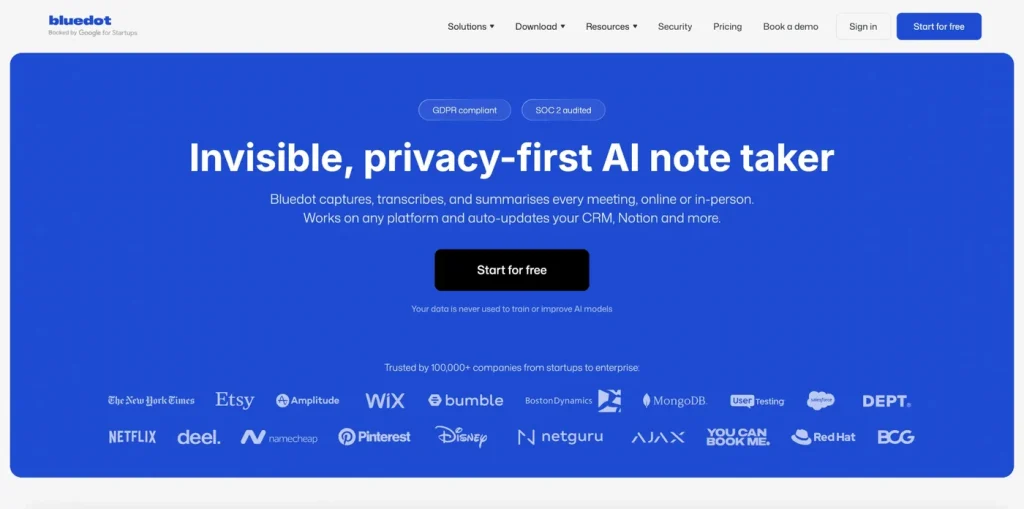
Bluedot is a privacy-first notetaker built in Europe. Data is stored mainly on AWS in Frankfurt, and teams can choose where it lives, including a US AWS region for recordings on request. Bluedot is GDPR-compliant and SOC 2 Type II audited, and it offers a DPA with standard contractual clauses and customer-specific terms. Customer data is never used to train AI models, so there is no opt-out to manage. Data is encrypted with AES-256 at rest and TLS in transit.
Retention is in your hands. Workspace admins can set custom retention for recordings, transcripts and AI notes, and Bluedot removes data three months after you stop using it, sooner on request, with backups cleared within 30 days. The recorder runs on your own device, so no bot joins the call by default, and it can post a recording notice in the meeting chat that admins can require across the workspace. Unlike most privacy-first tools, it records video as well as audio, labels speakers automatically and works on Chrome, Mac, Windows, iOS, Android and Apple Watch. Bluedot holds 4.8 on G2 across 226 reviews.
The catch: a replayable video or audio file holds more personal data than a transcript, so set a retention period before you roll it out, or use the transcript-only recording mode. Video needs the Pro plan ($20), Basic ($14) is audio only with a 1-hour limit per recording, and the free plan covers 5 recorded meetings of up to an hour each.
Best for: teams that want EU-hosted storage, a no-training guarantee and a replayable recording on every device.
Look elsewhere if: you want audio deleted automatically after every transcript. Jamie does that.
Pricing: Free (5 recorded meetings); Basic $14 per user per month billed annually ($18 monthly); Pro $20 ($25); Business $32 ($39); Enterprise on request.
2. Jamie: best for EU-only processing and no stored audio
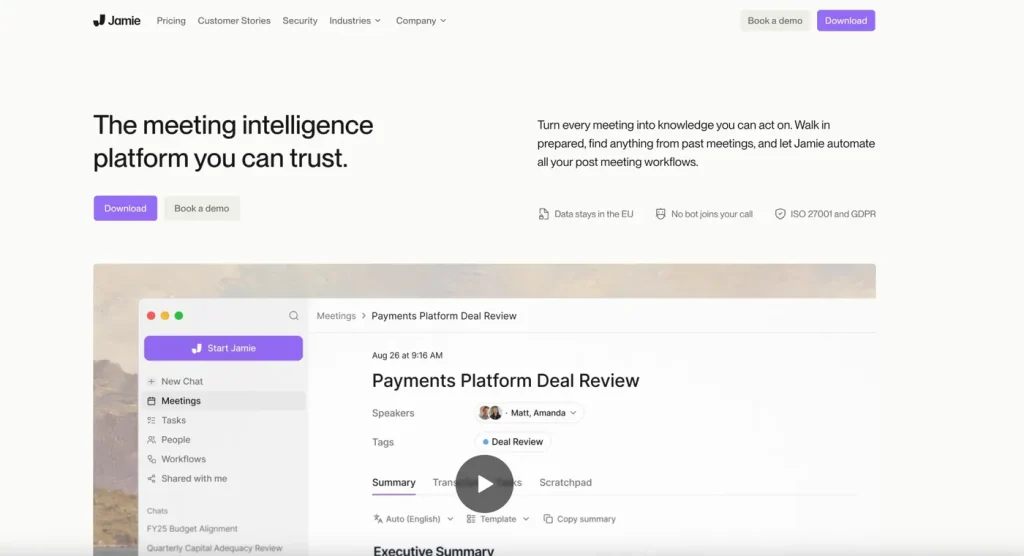
Jamie is built by wespond UG, a German company. Meeting content, including the audio streamed for transcription, stays within the EEA, Switzerland and the UK. Audio is deleted once the transcript exists, apart from a few seconds per speaker when Speaker Clips is switched on. Jamie lists ISO 27001, states that customer data is never used to train models and publishes an online DPA that names its sub-processors. It records online and in-person meetings without a bot.
The catch: with the audio gone, you cannot check a disputed quote against a recording, and there is no video. The free plan allows 10 AI notes a month with a 30-minute limit per meeting, and Plus allows 20 notes and two hours.
Best for: teams that want EU-only processing and no stored audio.
Look elsewhere if: you want to replay recordings, keep video or pay a lower per-seat price for a team.
Pricing: Free (10 notes a month); Plus €21 per month billed annually; Pro €39; Team €33 per seat.
3. tl;dv: best for European hosting with video clips
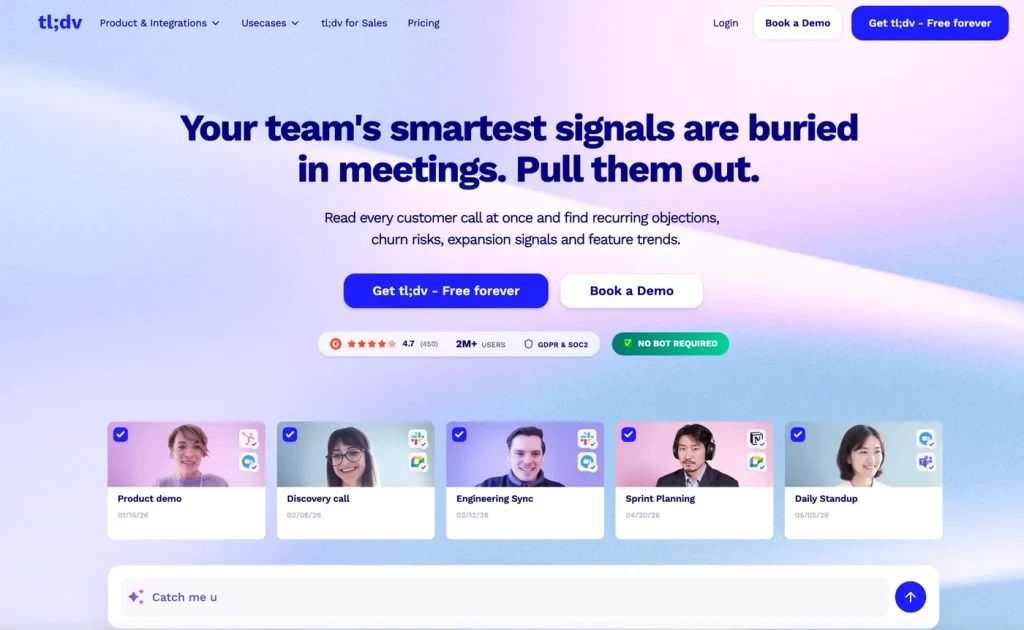
tl;dv’s security page names its infrastructure: storage on Wasabi, processing in private Google Cloud data centers and dedicated Hetzner servers, all located in Europe. It lists SOC 2 Type II and GDPR compliance, states that customer data is not used to train AI models and offers private AI hosting on request. tl;dv says you can choose whether AI processing runs in Europe or the US, and it publishes a DPA. It records video, turns moments into shareable clips and holds 4.7 on G2 across 530 reviews.
The catch: because the AI region is a choice, confirm that your workspace is set to Europe. Free recordings are deleted after about three months, AI notes stop at 10 meetings, and a bot joins calls by default. The desktop app avoids the bot but captures audio only.
Best for: teams that want European hosting and video clips of calls.
Look elsewhere if: you want video without a bot, or free recordings kept longer than three months.
Pricing: Free; Pro $18 per user per month billed annually; Business $29.
4. Leexi: best for a public DPA and named sub-processors
Leexi is a Brussels-based meeting assistant. It hosts on AWS in Paris, with a Scaleway option beyond certain license volumes, and runs its language models through Azure hosted in the EU, with Mistral as a European alternative. It holds ISO 27001 and states that it does not train on client data. Its DPA has been public since July 6, 2026, lists ten sub-processors with their hosting locations and is backed by a Trust Center. It is aimed at sales, customer success and recruiting teams, with CRM and VoIP integrations.
The catch: CRM and VoIP integration needs the Business plan, which has a three-user minimum. G2 shows a single review, so there is little independent feedback to check, and there is a one-week trial instead of a free plan.
Best for: European sales and recruiting teams that want to hand their DPO a public DPA and sub-processor list.
Look elsewhere if: you want a free plan or a large base of independent reviews.
Pricing: Starter $12 per user per month billed annually; AI-Meeting $23; Business $39.
5. Noota: best for French hosting and a text-only option
Noota hosts in EU data centers in France, Belgium and the Netherlands on Google Cloud, with encryption keys managed through Google KMS. It states that it does not train on customer data and supports access and deletion requests. A text-only mode avoids keeping audio or video. It covers Meet, Zoom, Teams, Webex and in-person meetings.
The catch: Noota’s GDPR page says the product is fully GDPR-compliant but names no certification and no DPA, so ask for both before you sign. The free plan keeps data for one month.
Best for: teams that want French hosting and the option to keep only text.
Look elsewhere if: your security review needs certifications and a DPA you can read before you contact sales.
Pricing: Free (300 AI-note minutes a month, one month of storage); Pro €19 per user per month (1,000 minutes, team workspace of up to 10 users); Business €39; Enterprise custom.
6. MeetGeek: best for a choice of EU or US data region
MeetGeek offers both EU and US residency. For European customers, production data stays in the EEA, and large language model analysis runs through an EU instance, so summaries are generated there too. It is audited yearly against SOC 2 Type II, holds ISO 9001 and signs a DPA with standard contractual clauses. Customers have 15 days to object to a new sub-processor, and MeetGeek states that meetings are not used to train AI models.
The catch: EU residency is a setting, so confirm your workspace is on the EU instance. Reviewers on G2 also describe MeetGeek sending promotional emails and chat messages to everyone in a recorded meeting, which is awkward when you are trying to control what participants are told. The free plan covers 3 hours of transcription a month.
Best for: teams that need a documented EU region and a DPA with SCCs at a low seat price.
Look elsewhere if: promotional messages sent to meeting guests would be a problem for you.
Pricing: Free; Pro $9.99 per user per month billed annually ($15.99 monthly, 20 hours a month, $0.50 for each extra hour); Business $17 ($27); Enterprise custom.
7. Fireflies: best for a searchable archive with transfer safeguards
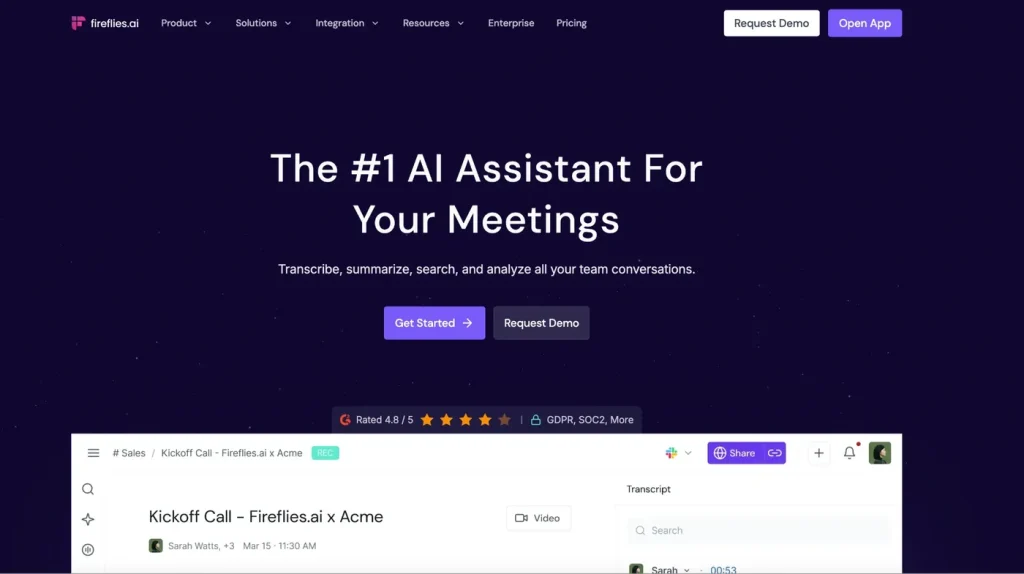
Fireflies is a US company. It lists SOC 2 Type II, GDPR compliance, ISO/IEC 42001 and a place on the EU-US Data Privacy Framework list, and it supports standard contractual clauses. On Business and Enterprise it acts as a processor under a DPA, and customers can object to new sub-processors. Its pricing page says your data is never used for AI training. It keeps every meeting searchable and holds 4.7 on G2 across 753 reviews.
The catch: EU storage comes only through Private Storage on the Enterprise plan, and processing still happens in the US. Retention and private storage controls are Enterprise features too. Fireflies is also the defendant in Cruz v. Fireflies.AI Corp., a proposed class action filed in Illinois in December 2025 under the state’s Biometric Information Privacy Act over its speaker recognition. The allegations are unproven.
Best for: teams that accept US processing, have transfer safeguards in place and want a searchable archive.
Look elsewhere if: you need EU-only processing or EU storage below the Enterprise price.
Pricing: Free; Pro $10 per user per month billed annually; Business $19; Enterprise $39.
What the vendor cannot do for you
Roles and the DPA
When your company records a meeting, your company is the controller and the note taker is the processor. Article 28 requires a written contract with set terms: processing only on your documented instructions, security measures, no new sub-processor without your authorization, help with data subject requests, deletion or return of the data at the end, and audit access. A processor that starts using your meetings for its own purposes, model training for example, is treated as a controller for that use under Article 28(10). The training answer therefore belongs in the DPA as well as on the marketing page.
Lawful basis and notice
You need a lawful basis for recording and transcribing people. Bavaria’s data protection authority has said consent is often invalid between employer and employee, and that clicking “agree” on a bot’s pop-up is not informed consent and usually does not meet the Article 13 information duty. Many internal meetings rely on legitimate interest under Article 6(1)(f), which means documenting a balancing test. For outside guests, tell them before the call, for instance in the invitation. In Germany, recording the spoken word can also fall under Section 201 of the Criminal Code, so notice and agreement matter beyond data protection law. A bot-free recorder changes what participants see and leaves these duties as they were.
Transfers
A DPA does not cover data leaving the EU. Sending data to a US vendor needs its own mechanism, either certification under the EU-US Data Privacy Framework or standard contractual clauses. The EU General Court upheld the Framework on September 3, 2025, and Philippe Latombe appealed to the Court of Justice in October 2025. A vendor that relies on the Framework alone carries that risk, so look for SCCs as well. Storage and processing are separate questions: Fireflies’ EU private storage keeps files in the EU while processing happens in the US, and tl;dv lets you pick the AI region.
Retention, rights and impact assessments
Set a retention period before the first meeting is recorded. People can ask for access and deletion, so you need to find and remove one person’s data across transcripts and recordings. If you record employees systematically or discuss sensitive subjects such as health, Article 35 can require a data protection impact assessment, and some public bodies ask for one before any AI note taker is used.
This is general information, not legal advice.
Built-in and popular tools
Microsoft 365 Copilot in Teams is an EU Data Boundary service for EU customers, though Microsoft notes that models provided by Anthropic as a subprocessor are currently excluded from the boundary. Zoom says it does not use customer audio, video, chat or attachments to train Zoom’s or third-party models. Otter, Fathom and Granola use de-identified meeting data for training by default and offer opt-outs, and Otter’s data resides in the United States. An EU team using one of them needs the opt-out switched on and a transfer check in place.
What does it cost for a team of 10?
The plans are not like for like, so read the notes. Prices are per month for ten users on annual billing, using the cheapest plan that covers the feature named in brackets.
| Tool | Plan used | Monthly cost for 10 users |
|---|---|---|
| Bluedot | Basic (audio, EU storage) | $140 |
| Bluedot | Pro (video) | $200 |
| Jamie | Team | €330 |
| tl;dv | Pro | $180 |
| Leexi | AI-Meeting | $230 |
| Noota | Pro | €190 |
| MeetGeek | Pro (20-hour monthly cap per user) | $99.90 |
| MeetGeek | Business (unlimited transcription) | $170 |
| Fireflies | Pro (US storage) | $100 |
| Fireflies | Enterprise (EU private storage) | $390 |
Leexi’s Business plan, which adds CRM and VoIP integration, costs $390 for ten users.
Which tool should you choose?
- For EU-hosted privacy with video and audio you can replay, on any device, Bluedot.
- If you want EU-only processing and no stored audio, Jamie.
- If you want European hosting and video clips, tl;dv, with the AI region set to Europe.
- If your DPO wants a public DPA and sub-processor list, Leexi.
- If you want French hosting and a text-only mode, Noota, after you have its DPA and certificates.
- If you want to pick between an EU and a US region at a low seat price, MeetGeek.
- If you accept US processing and have transfer safeguards, Fireflies. For EU storage, plan for Enterprise.
- If you already live in Microsoft 365, Copilot in Teams.
FAQ
Is there a GDPR-compliant AI note taker?
GDPR compliance describes how you use a tool, so no product is compliant on its own. Some tools make it easier with EU storage, a signable DPA, no training on your data and retention controls. Bluedot, Jamie, tl;dv, Leexi and MeetGeek document most of these publicly.
Do I need consent to use an AI note taker?
You need a lawful basis, and consent is only one option. Bavaria’s authority says consent is often invalid between employer and employee, and legitimate interest with a documented balancing test is the usual route for internal meetings. Participants need to be told before the meeting either way.
Do I need a DPA with an AI note taker?
Yes. Article 28 requires a written contract whenever a processor handles personal data for you. Bluedot, Jamie, Leexi, MeetGeek, tl;dv and Fireflies publish or offer one, and Noota’s GDPR page does not mention one.
Is EU hosting enough?
EU storage answers one question. Ask where AI processing runs, who the sub-processors are and whether the vendor is a US company subject to transfer rules. Fireflies stores in the EU only on Enterprise and processes in the US, and tl;dv lets you choose between a European and a US AI region.
Can I use a US-based note taker?
Yes, with a transfer mechanism: Data Privacy Framework certification or standard contractual clauses, ideally both. Fireflies is on the Framework list and supports SCCs. The Framework survived a challenge at the General Court in September 2025 and is under appeal.
Do I need a data protection impact assessment?
Article 35 requires one when processing is likely to result in a high risk to people. Systematic recording of employees or meetings about sensitive subjects can meet that bar. Some public bodies require one before any AI note taker is used.
Are Zoom and Teams AI notes GDPR-compliant?
The same rule applies: the tool helps and your setup decides. Copilot in Teams is an EU Data Boundary service for EU customers, and Zoom says it does not train on customer audio, video, chat or attachments.
Does a bot-free recorder change my GDPR duties?
No. It changes what participants see in the call. A recorder nobody can see leaves the announcing to you, so pick one that can post a notice automatically. Bluedot can post it in the meeting chat, and admins can require it for the whole workspace.
For a wider look at the category, see our best AI note-takers and our Bluedot review. For tools that never train on your meetings, see our guide to AI note takers that don’t train on your data, and for a head-to-head of the two EU-hosted options, Bluedot vs Jamie.